Case study · Remedial waterproofing
Rooftop Waterproofing Remediation
Residential apartment complex, Sydney NSW
From a failed rooftop membrane to a fully compliant, future-proofed 20-year solution.
- Project type
- Remedial waterproofing – full rooftop membrane replacement
- Location
- Residential apartment complex, Sydney NSW
- Macquarie FM role
- Building management
- Remediation contractor
- Danrae Group – waterproofing remediation specialists
- Membrane system
- Suprema PVC single-ply sheet membrane, 20-year warranty with manufacturer back-to-back cover
- Status
- Completed
The Problem
The liquid-applied waterproofing membrane on the rooftop of this residential apartment complex had deteriorated and failed. Water was finding its way through the roof slab and into the building, with multiple residents reporting leaks into their apartments. Investigation also identified hairline cracking in the concrete roof slab beneath the membrane.
Water ingress is one of the most deceptive problems a building can face. A leak inside an apartment can be far from where the water is getting in, so accurate diagnosis is critical before spending money on repairs. In this case, the diagnosis was clear: the rooftop membrane had reached the end of its serviceable life and needed complete replacement.
Another complication was on top of the roof itself: an existing solar panel installation that needed to be removed and disposed of before any remediation work could begin, and it shaped key design decisions about the roof’s future.
Getting the Design Right
Rooftop remediation of this scale is rarely straightforward, and this project illustrates why professional, client-side guidance matters.
In the early stages, several contractors priced the job, but against different scopes and products. Some proposed liquid-applied membranes, others sheet membrane systems. Because the quotes weren’t comparable, the Owners Corporation had no reliable basis for a decision. This is a very common situation in remedial work, and it’s precisely where projects stall.
Liquid membrane or sheet membrane?
The tempting option
Liquid membrane
A liquid membrane is painted or applied wet and cures into a flexible waterproof layer. It’s versatile, and the material cost is generally lower – which makes it the tempting option on paper.
However, a liquid membrane’s performance depends heavily on application conditions: substrate preparation, slab moisture content, ambient temperature, humidity, number of coats, and achieved thickness. Get any of these wrong – or rush the curing time – and the membrane can fail well short of its intended life. Many waterproofing defects across the industry trace back to these application variables.
Specified for this project
Sheet membrane – Suprema PVC single-ply
A sheet membrane arrives from the factory at a guaranteed thickness. The Suprema PVC system offered several decisive advantages:
- Guaranteed thickness – the waterproofing performance is built into the manufactured product, not dependent on on-site conditions during application.
- Fewer joints – the PVC sheet comes in two-metre widths, and when the joints are heat-welded, the membrane becomes monolithic: the welded joint is actually stronger than the membrane itself.
- No curing time – the sheet can be walked on as soon as it’s laid, significantly shortening the programme.
- Longer lifespan – PVC retains its plasticisers longer than bitumen-based alternatives and is specifically engineered by manufacturers for exposed rooftops.
- Solar reflectivity – the membrane’s colour and composition reflect heat off the roof.
- A 20-year warranty, backed by a manufacturer back-to-back warranty: if the installing contractor is ever unavailable, Suprema – a manufacturer with a history stretching back nearly a century – stands behind the membrane directly.
While a liquid membrane was the preferred material in the past, the whole-of-project and whole-of-life picture told a different story. Longer lifespan, stronger warranties, reduced risk of defects and less future deterioration to the roof and the apartments below made the sheet membrane the prudent choice – and the one consistent with the standards now expected under NSW's building legislation.
The Works
Danrae Group delivered the remediation from start to finish:
-
Removal and disposal of the existing solar panel installation to clear the roof for remediation.
-
Grinding off the failed liquid membrane back to the concrete substrate.
-
Treatment of hairline cracking in the roof slab, including epoxy injection.
-
Correcting the falls of the roof to achieve compliance, using an innovative approach: an engineered, fibre-reinforced screed pumped up to the rooftop directly from a truck rather than mixed manually on site. This saved an enormous amount of time, and the engineered mix set quickly, keeping the programme moving.
-
Installation of the Suprema PVC sheet membrane, heat-welded into a single monolithic waterproof layer across the entire roof.
Future-Proofing the Rooftop
One of the most valuable – and most overlooked – aspects of a remediation project is what happens to the roof after the work is finished.
A pattern we see repeatedly across the industry: a rooftop is remediated at high cost, and sometime later the building decides to add solar panels, an air-conditioning plant or other equipment. A contractor drills through the new membrane to fix the equipment down – and in doing so voids the membrane warranty, often without anyone realising until water reappears. At that point, no contractor can reasonably be asked to re-certify a membrane that others have penetrated, and the Owners Corporation can be left facing the cost of the roof all over again.
This project was designed to prevent that scenario. The PVC system allows special fixing bars – with extruded aluminium encapsulated inside the membrane material – to be heat-welded onto the roof. Equipment such as solar arrays, tanks, HVAC plant or Unistrut framing can then be secured to these bars without a single penetration of the waterproofing layer, preserving the warranty in full.
The lesson
Think about the end game for your rooftop before you design the remediation. Building future capability at the design stage is far cheaper and far less complicated than retrofitting it later.
Compliance: The Design and Building Practitioners Act
This project was delivered under the framework of the Design and Building Practitioners Act 2020 (NSW), which has fundamentally raised the bar for remedial work on class 2 (apartment) buildings:
- A registered design practitioner must declare that the design complies with the Building Code of Australia.
- A registered building practitioner must declare that the work has been built in accordance with that declared design.
- These declarations are lodged with the NSW Government’s planning portal, creating a permanent compliance record.
The Act also means that once a rooftop design is declared and built, later modifications are not a casual matter. Adding equipment to the roof can raise the question of whether the declared design is being altered – potentially requiring a design practitioner to be re-engaged. This is another reason the future-proofing decisions made at design stage on this project matter so much: they keep future works within the envelope of the compliant design.
Under this legislative environment, the industry is moving away from short-life rooftop solutions. Designers and contractors are being appropriately prudent about the systems they specify – and while more robust systems can carry a higher upfront cost, they deliver longevity, stronger warranties and dramatically lower long-term risk for owners.
The Value of a Client-Side Project Manager
What makes Macquarie FM different from most building management companies is that our expertise is grounded in building. As a Registered Building Practitioner, Paul Shelley can act on your project as the Owners Corporation's client-side project manager and superintendent – a role that is emerging as essential in remedial construction. This role includes:
Engaging and liaising with the design practitioner to develop a compliant scope of works and design.
Running the tender process so that experienced remediation contractors are pricing an identical, well-defined scope.
Evaluating tenders with an experienced eye. The lowest price is not automatically the right price. A tender that comes in substantially below the others often signals that something has been missed – which can surface later as claimed variations, disputes, or worse, a contractor unable to complete the work.
Chairing regular site meetings with the contractor throughout the project.
Assessing progress claims to ensure the Owners Corporation paid fairly and reasonably for work completed – and translating construction terminology (from "preliminaries" to "extensions of time") into plain language the committee could act on.
Administering the contract impartially, including obligations that are legally binding on both sides, such as legitimate extensions of time for inclement weather.
Acting as a conduit between the contractor and the Owners Corporation – talking to the builder as a builder, and to the committee as trusted advisors – to keep the project moving and keep disputes to a minimum.
An Owners Corporation has a duty to act in the best interests of all owners and to maintain the common property. But committees are made up of volunteers, and even where individual members bring professional backgrounds, taking direct control of a remedial project can create conflicts of interest and expose the scheme to risk. An arm's-length, qualified professional managing the project on the owners' behalf removes the personalities from the process and puts the decisions on a sound technical and contractual footing.
Because that capability is embedded within our building management service, Owners Corporations working with Macquarie FM get client-side project management and superintendence from people who already know their building – not as an expensive add-on from a stranger to the site.
The Outcome – and the Lesson
The building now has a fully compliant rooftop protected by a monolithic PVC membrane with a 20-year warranty and manufacturer-backed cover – engineered not just to keep the water out today, but to accommodate the building’s future needs without compromising the waterproofing.
18.5%
Industry price rise
Between the first tender on this job and contract signing, industry pricing rose by around 18.5% – a product of material supply pressures, trade shortages and rising compliance standards across the sector. When a building defect is identified, acting decisively is almost always the most cost-effective path. Delay rarely makes remedial work cheaper; it usually makes it dearer, while the underlying damage continues.
With the right diagnosis, the right design, the right contractor and experienced client-side management, even the most complex remediation can be delivered smoothly – faster, with less angst, and with far lower risk for every owner in the building.
Strata Schemes Management Act 2015 (NSW)
Owners Corporation Obligations – Section 106
Under Section 106 of the Strata Schemes Management Act 2015 (NSW), an owners corporation has a statutory duty to properly maintain and keep in good repair the common property of the building. This includes structural elements such as lift pits and basement walls.
Owners corporations that are made aware of a defect and fail to act may expose themselves – and potentially individual committee members – to claims of negligence and breach of their duty of care. Conversely, engaging appropriately qualified professionals to investigate, design and manage remedial works is the clearest way for an owners corporation to demonstrate it is meeting its obligations.
Facing a waterproofing or remedial building issue?
Macquarie FM provides building management with genuine construction expertise built in – including client-side project management and superintendence by a Registered Building Practitioner. If your building has a defect that needs diagnosing, or a remedial project that needs safe hands, talk to us before you go to tender.
Remedial works · Pre-construction complete
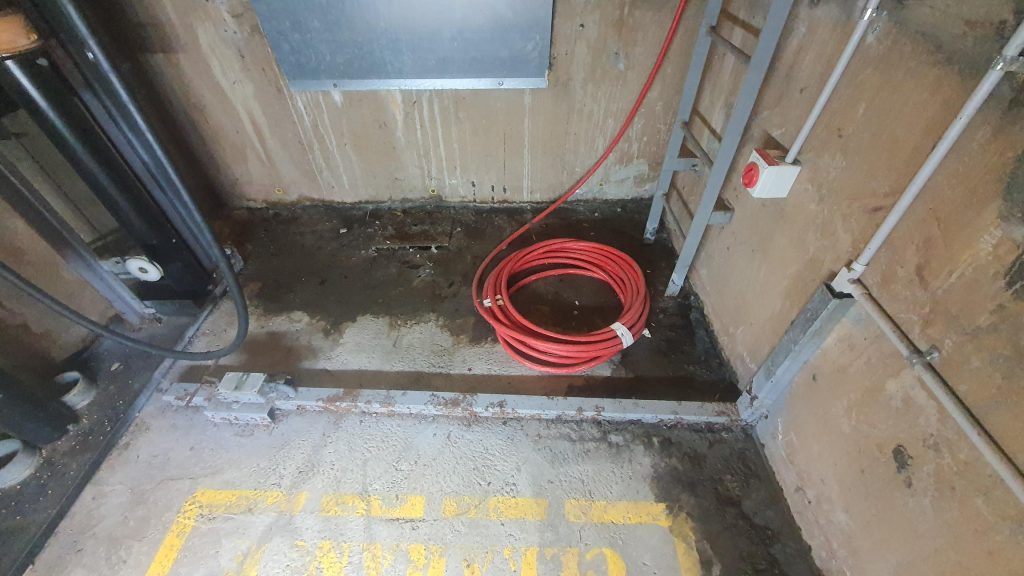
Lift Pit Water Ingress
Water entering the lift pits through walls and construction joints threatened the building's shear walls. Investigation, a compliant DBP Act design and a four-contractor tender evaluation – delivered for the Owners Corporation.
Read case study